
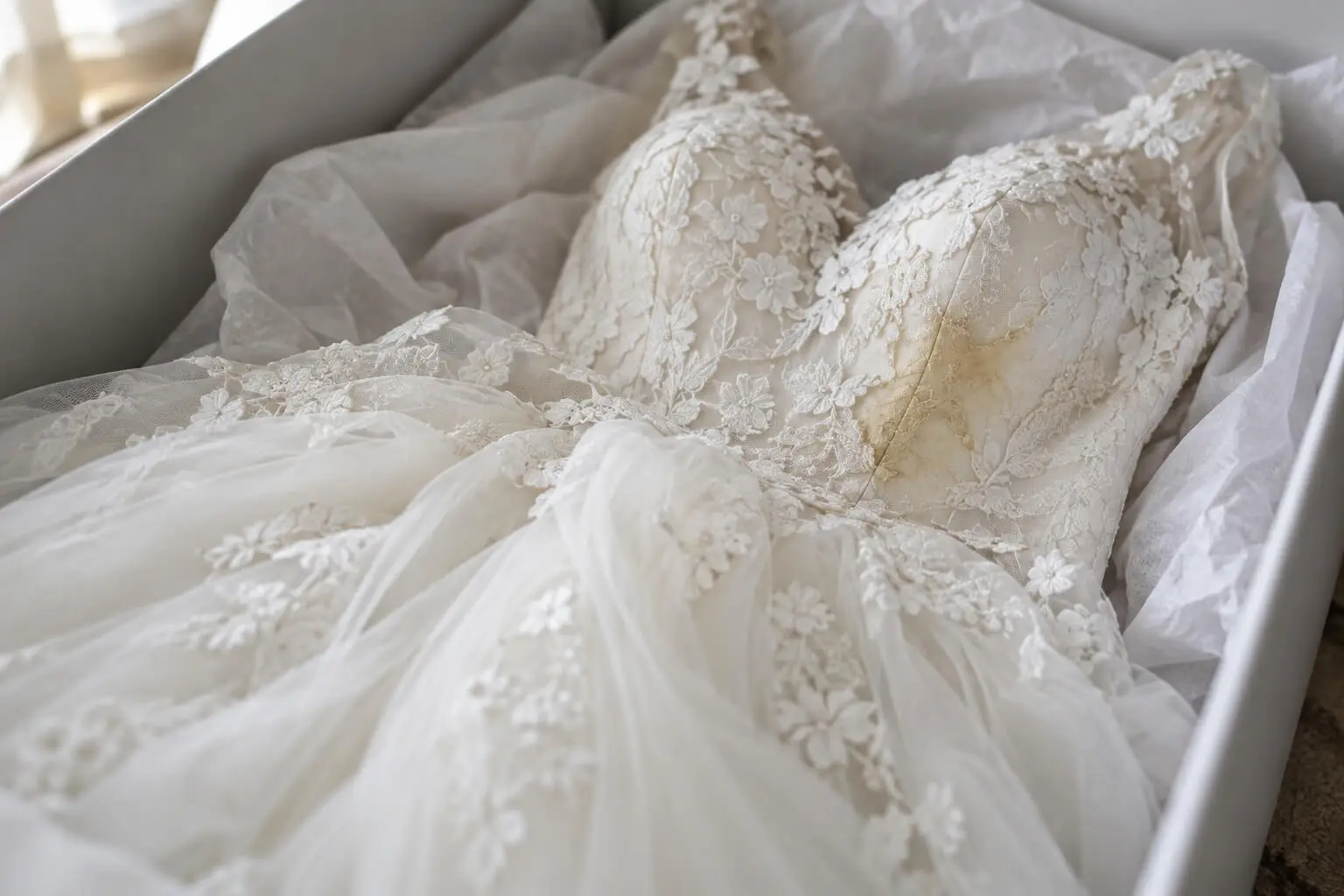
You followed the advice everyone gave you: have your dress cleaned after the wedding, place it in a plastic garment bag, and store it safely in the closet. Now you pull it out and find yellow or brown patches, and it doesn’t make sense.
That is not something you did wrong. Why does a wedding dress turn yellow even after cleaning and careful storage? Five specific causes explain most of it, and they often combine on the same dress. Here is what is actually happening to your dress, and how to tell with which cause you are dealing.
Cause #1
Sugar Oxidation From Invisible Reception Spills
Champagne, cake frosting, and sweetened tea can reach your wedding dress without leaving a visible mark. Once the liquid dries, the fabric may look clean, but the sugar remains inside the fibers.
Over the next six to twelve months, oxygen reacts with that residue and produces yellow or brown compounds. The process resembles the browning of a sliced apple, although it happens far more slowly. It can continue at room temperature and in dark storage, which explains why discoloration may appear even when you keep the dress covered.
Sugar oxidation often follows this pattern:
- A clear spill dries without changing the color of the fabric.
- Sugar residue stays embedded in the threads.
- Oxidation gradually darkens the affected area.
- A defined yellow or brown stain appears months later.
Even a small champagne splash can eventually produce a fist sized mark as moisture spreads through nearby fibers during the reception itself, well before any oxidation has actually started.
The giveaway: look for isolated spots rather than uniform yellowing, particularly along the hem, bodice, waistline, or any area touched by a glass, plate, or dessert covered hand.
Cause #2
Body Oil Migration and Oxidation
Your skin naturally transfers perspiration, oils, and product residue to your wedding dress throughout the day. Heat, movement, and the weight of the dress increase that transfer, especially where the fabric stays close to your body for hours at a time.
Unlike a sugary spill, oil rarely remains at its original contact point. It moves outward through the weave by capillary action, gradually affecting a wider area than the original contact point ever covered. As oxygen reacts with the transferred lipids, the fabric develops a soft yellow cast rather than a sharply defined stain.
Check the areas that received the most contact:
- Underarms, where perspiration and deodorant collect.
- Necklines and bodices exposed to skin oils or makeup.
- Waistbands pressed against the body for hours.
- Back panels touched during dancing or fastening.
- Sleeves and cuffs that repeatedly brushed against skin.
The giveaway: look for broad, diffused yellowing across the bodice, underarms, or back instead of isolated spots.
Many dresses show both oil oxidation and sugar staining at once. Hours of wear create steady oil transfer across broad areas, while reception spills add concentrated sugar residue in separate, more isolated areas, which is exactly why a single dress can show both patterns simultaneously without either one being the sole explanation.
Cause #3
Off-Gassing From Plastic and Standard Storage Materials
Cleaning removes stains and residue, but it cannot protect your dress from a poor storage environment. The materials surrounding the dress can create a separate, entirely independent source of yellowing.
Plastic garment bags and ordinary cardboard boxes are not chemically inert. As they age, they release vapors that can migrate into the fabric and react with its fibers. Standard tissue paper may also introduce acids unless the manufacturer specifically labels it as acid-free.
Common storage risks include:
- Plastic bags that trap moisture and release degradation compounds.
- Cardboard boxes made from acidic wood pulp.
- Colored tissue paper that may transfer dyes.
- Non-archival paper that becomes increasingly acidic with age.
The giveaway: look for consistent yellowing across most or all of the dress rather than defined spots around the bodice or hem. Even a professionally cleaned, stain-free dress can yellow after years inside the wrong container.
Cleaning and storage address two genuinely different risks. Your dress needs both proper treatment and archival quality materials to actually remain protected, since neither one covers what the other is specifically responsible for.
Cause #4
Ambient Light Exposure Over Years
Light can change the color of your dress even when direct sunlight never actually reaches it. Low level exposure from a nearby window, the gap beneath a closet door, or an overhead bulb can trigger photooxidation, a reaction that gradually breaks down fibers, dyes, and optical brightening agents over time.
The risk increases when:
- The garment bag allows light to pass through.
- Closet lights remain on for extended periods.
- The dress sits near a window or doorway.
- Sensitive fabrics, particularly silk, lack archival protection.
Silk often shows a stronger yellow shift than polyester because its natural protein fibers react more readily to light and oxygen at a molecular level, a distinction covered in more depth later in this piece.
How to check: place the dress beside a new white shirt or a freshly washed white sheet. This side by side comparison can reveal gradual discoloration that your eyes may genuinely miss when viewing the dress alone, since the shift happens slowly enough that you adjust to it without noticing.
Cause #5
Humidity Cycles That Reactivate Compounds in the Fabric
Professional cleaners often see humidity overlooked because the damage comes from repeated changes, not one damp day. Attics, basements, garages, and closets along exterior walls can shift between humid and dry conditions daily or seasonally, often without anyone actually noticing the swing.
During each cycle, fabric absorbs and releases moisture. That movement can help previously deposited sugar, body oil, and cleaning residue spread further through the fibers and react with oxygen more readily. Higher moisture levels may also accelerate chemical breakdown and create conditions for mildew alongside the yellowing itself.
The risk increases when you store the dress in:
- A garage with large temperature swings.
- An attic that becomes hot and humid.
- A damp basement.
- A closet against an exterior wall.
- A container that traps moisture.
The giveaway: compare the storage environment, not just the dress. A dress kept in a climate controlled interior closet will usually resist yellowing longer than one stored in a garage, even when neither dress shows an obvious spill or visible contamination that would otherwise explain the difference.
How the Five Causes Multiply Each Other
Yellowing rarely comes from just one cause. These five factors interact directly, and each can make the next reaction move faster rather than simply adding to the total damage independently.
- Humidity gives hidden sugar residue more chances to oxidize, since moisture cycling through the fabric accelerates the same chemical reaction covered in cause one.
- Moisture helps body oils travel farther through the fabric than they would in stable, dry conditions, extending the migration pattern covered in cause two.
- Warm temperatures increase plastic off-gassing specifically, since heat speeds up the actual chemical release from storage materials rather than simply adding humidity damage on top.
- Light attacks fibers already weakened by stains and chemical residue more aggressively than it would attack genuinely clean fabric.
One factor alone may change a dress slowly, over a decade or more. Combine three or four of them, and deterioration can genuinely accelerate rather than simply increase in proportion, since each active cause makes the others work faster rather than operating in isolation.
That is exactly why two dresses cleaned at the same time, by the same specialist, using the same process, can age very differently afterward. One may remain bright for a decade in cool, climate controlled archival storage, while another turns yellow within two years in a warm, humid closet, purely based on what happened to each dress after the cleaning was already finished.
Why Silk and Satin Yellow Faster Than Polyester
Not every wedding dress ages at the same rate, even under otherwise identical conditions. Fiber chemistry determines how strongly the material actually reacts with oxygen, light, moisture, and residue at a molecular level.
The main differences are:
- Silk: this natural protein fiber contains amino acid groups that participate directly in oxidation reactions, making it especially vulnerable to yellowing and light damage compared to fibers that simply hold residue passively.
- Satin: satin describes the weave, not the fiber. A satin dress may contain silk, polyester, or a blend, so check the care label before judging its actual risk based on how the fabric looks or feels.
- Polyester: this synthetic fiber resists many oxidation reactions better than silk, although light, trapped residue, and storage vapors can still discolor it over enough time.
A neglected polyester dress may remain bright for years under conditions that would badly yellow a silk dress in a fraction of the time, since polyester simply doesn’t carry the same reactive chemical structure as protein fibers in silk. Silk and silk blend satin therefore require genuinely careful cleaning and archival storage from the very start, rather than the more casual handling a synthetic dress might tolerate without consequence.
What to Do Before Attempting Any Fix
Before you try to fix anything yourself, there is one thing to avoid and a few things to do.
Skip the bleach, the hydrogen peroxide, and the home whitening remedies you will find online. They frequently damage delicate fibers permanently, and that damage limits what a professional can actually do later, even when the attempt seems to lighten the color somewhat in the moment.
Instead:
- Photograph the dress in natural daylight to document its current condition.
- Note where the yellowing is worst, since the pattern points directly to the actual cause.
- Take the dress out of any plastic bag right away, regardless of how long it’s already been in there.
Once that is done, take it to a professional for wedding dress cleaning that starts with identifying the actual cause, not a generic process that may miss the real problem entirely and treat the wrong thing.
Help Restore Your Wedding Dress with Expert Care from B&C Cleaners
Whether yellowing comes from oxidized sugar stains, acidic storage materials, or prolonged humidity, B&C Cleaners professionals begin by identifying the cause and examining the fabric, dyes, and embellishments of the dress. This honest assessment determines what restoration can safely improve before a wedding dress cleaning and preservation plan is recommended.
Harrison County brides can have their dresses evaluated at B&C Cleaners’ convenient Marshall location without committing to a one-size-fits-all treatment. Call today to schedule your wedding dress assessment.
Address: 201 S. Washington Ave., Marshall, TX
Phone:+1 903-605-1127
Email: jordan@bandccleaners.com